Showing posts with label bullying. Show all posts

Saturday, February 26, 2011

This is What I Did by Ann Dee Ellis


This is What I Did. Ann Dee Ellis. Little, Brown and Company, c2007. 157 pages.

Plot: Ann Dee Ellis’ This is What I Did is narrated by thirteen-year-old eight grader Logan Paloney. Logan is struggling to move past a violent encounter he witnessed between his friend Zyler, Zyler’s abusive father, and a girl named Cami the previous year. Though Logan’s family moved Logan and his younger twin brothers across town after the incident and enrolled Logan in a new middle school, Logan’s life hasn’t gotten any easier. His new classmates (and even one classmate’s father) bully him terribly. However, Logan begins to see a counselor and begins a friendship with a girl named Laurel and is eventually able to confront his feelings about what had happened.

Review/personal thoughts:
Ellis’ fragmented writing style and use of almost screenplay-style dialogue accurately portrays, I believe, the thought process of a young boy who has been through something traumatizing. A quick and engaging read, its honesty will appeal to tween readers.

Having done nothing to help his friend Zyler when he witnessed a violent encounter between Zyler, Zyler’s father, and Cami, Logan struggles with feelings of shame. He not only feels guilty because he feels he wasn’t a good friend to Zyler, but he also feels guilty because of the ways in which his family’s life has changed since the incident. When Logan’s parents take him out for a milkshake, leaving his twin brothers behind, he thinks: “I felt guilty they were taking me without the others, at first, but then I realized it made sense since everything was about me: Dr. Benson, me getting the best room, the playoff tickets, and now shakes” (Ellis, 2007, p.124).

Because Logan feels guilty that his parents are concerned about him, he constantly assures them that he is fine. He doesn’t trust that his family won’t judge him if he is honest about what had happened and the way it has affected him. He also doesn’t trust his new friend Laurel will still want to be his friend if she knows the truth about what happened. However, Logan eventually begins to open up and in the end even finds the courage to email Zyler, who he hasn’t spoken to since the incident.

Tweens will relate to Logan's difficulty overcoming his shame, and will benefit from his journey towards forgiveness—towards forgiving himself as well as Zyler.

Genre: contemporary realistic fiction

Reading level: ages 12-up

Awards:
Nominated for Quick Picks for Reluctant Readers
American Library Association - Best Books for Young Adults
Voice of Youth Advocates - 2007 Top Shelf Fiction for Middle School Readers List

Monday, February 21, 2011

Parrot in the Oven, Mi Vida by Victor Martinez

Parrot in the Oven, Mi Vida. Victor Martinez. HarperCollins Children’s Books, c1996. 216 pages.

Plot:
Victor Martinez’s Parrot in the Oven, Mi Vida is a coming of age story following Manuel Hernandez, a fourteen year old Mexican American boy. The novel follows Manuel’s life in the year leading up his test of courage and initiation into a neighborhood gang. Manuel, who is smart and well behaved, struggles to find his place in the world while battling hardships often brought on by his dysfunctional family. Though he must contend with an alcoholic and sometimes violent father, a mother who turns a blind eye to his father’s behavior, poverty, bullies, racism, and more, Manuel does discover in the end what being a vato firme, a guy to respect, means to him.

Review/personal thoughts:
Though highlighting issues such as alcohol abuse, violence, poverty, bullying, and racism, Parrot in the Oven is a beautifully told story that I believe mature tweens will find benefit in reading. Martinez’s descriptions are rich and always right on, and were a delight to read.

Even more valuable than Martinez’s stunning prose, however, is the message his novel delivers. Growing up with a dysfunctional family in the projects, Manuel knows that it’s difficult for a kid like him to make something of himself. In his neighborhood, a man earns respect by joining a gang.
Manuel passes the Test of Courage to become a member of the Callaway Projects gang, but discovers soon afterward that the gang’s definition of a man to respect differs greatly from his own. He realizes this when he witnesses Eddie, one of the gang’s members, mug a woman coming out of the bank. “It was like I’d finally seen my own face and recognized myself; recognized who I should really be. Then I didn’t feel like catching up to Eddie anymore. Instead, I wanted to grab him, and scold him about how to treat people, how to be somebody who knows how to treat people: like my sister; like that lady” (Martinez, 1996, p.210). 

Though Manuel struggles with the difficult circumstances of his environment, in the end he doesn’t allow himself to fall victim to it. Through Manuel’s journey, Martinez demonstrates to his readers the importance of not allowing outside factors (whether these be your neighborhood, parents, peers, friends, race, social class, etc.) to define you. Tweens will benefit from Manuel's demonstration of self-determination and empowerment. 

Genre: contemporary realistic fiction

Reading level: ages 12-up

Awards:
Pura Belpre Author Award, 1998
Americas Award for Children’s and Young Adult Literature, 1996
National Book Award for Young People’s Literature, 
1996 

Blubber by Judy Blume

Blubber. Judy Blume. Yearling, c1974. 153 pages.

Plot:
Judy Blume’s Blubber is told from the point of view of Jill Brenner, an average fifth grade girl. When one of Jill’s classmates, an awkward and overweight girl named Linda, gives an oral report on the whale and references the whale’s “blubber,” another classmate, Wendy, passes a cruel note around the class. “Blubber is a good name for her!” (Blume, 1974, p.5), the note says. Wendy is clever and very popular and for these reasons Jill laughs at the note, even though she doesn’t find it particularly funny. Unfortunately for Linda, the name sticks and most of Mrs. Minish’s class (including Jill) joins Wendy in bullying “Blubber.” However, when Jill finds herself the victim of Wendy’s cruelty, she learns what it’s like to be on the other side of the bullying.

Review/personal thoughts:
Though I had read Blubber once when I was a tween, I found the novel almost shocking the second time around. Jill, Wendy, and the others in Mrs. Minish’s class positively terrorize poor Linda. They physically assault, humiliate, and threaten her on a daily basis. In one particularly disgusting incident, Jill, Wendy, and Wendy’s best friend Caroline meet Linda in the girls’ bathroom. While Wendy and Caroline hold her still, Jill begins to strip Linda’s clothes off of her.

While reading Blubber, I found myself aching to intervene and help Linda and felt little to no warmth towards Jill as a character. However, when Jill grows tired of obeying Wendy’s every command and stands up to her, she finds herself the class’ new target. This was an important turn in the plot, as it illustrates to readers how quickly the tables can turn. Though Jill had once been one of Linda’s main tormentors, and had thus gained Wendy’s acceptance, she loses this acceptance as soon as she asserts her independence. Wendy and Linda then team up in bullying Jill, referring to her as “Baby Brenner.” 

Jill’s relationship with Wendy is juxtaposed with her relationship with her best friend, Tracy Wu, in the novel. While Jill must perform for Wendy in order to gain her acceptance, Tracy and Jill can sit and be quiet together; “best friends don’t have to talk all the time” (Blume, 1974, p.133). Their relationship is revealed in the novel as one based on true friendship.

Judy Blume’s Blubber is an important novel for tweens to read as it showcases the often secret and shameful problem of bullying. Though Jill is initially the bully, she winds up the one being bullied in the end and discovers the affect her behavior has had on Linda. Blubber also reveals her relationship with Wendy as both manipulative and destructive, and demonstrates true friendship in her relationship with Tracy.

Genre: contemporary realistic fiction

Reading level: ages 9-12

Awards: 
Arizona Young Readers Award
Young Reader’s Choice Award, Pacific Northwest Library Association, 1977
North Dakota Children’s Choice Award, 1983

Thursday, February 17, 2011

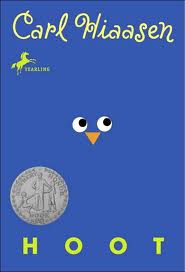
Hoot by Carl Hiaasen

Hoot. By Carl Hiaasen. Alfred A. Knopf, c2002. 292 pages.

Plot: The story centers around Roy Eberhardt a Middle School student who is new to the town of Coconut Grove, Florida. Roy enters into some unlikely friendships with “Mullet Fingers” a homeless boy and Mullet’s sister, Beatrice. Central to the story is a patch of ground slated to be bulldozed to make way for the 469th location of a Mother Paula’s All-American Pancake House restaurant. At first, the vandalism at the site seems random, but it is discovered that there is a community of burrowing owls on the site whose habitat will be destroyed by the construction and it is the presence and desired protection of these owls that are the focus of the vandalism. Roy discovers this fact through “Mullet Fingers” and is drawn into the cause of saving the owls. Through Roy’s persistence, he discovers the owls are a protected species, that the company knows the owls are there but deny it, that the environmental impact report has been hidden and that city officials have been bribed! The story builds to a great scene at the groundbreaking ceremony which yields surprises that will delight the reader.


Review/Personal thoughts: Hoot is a great read! Many themes are visited and cleverly revealed in the book. Bullying, friendships, parent child relations and middle school life are all part of the story. Also included are corruption, anti-development and the beauty of nature as themes. There are many eccentric characters and many normal characters, all of which are made completely believable. I enjoyed the ineptitude revealed in the well-meaning adults like the police officer and site supervisor. There is an element of humor that runs throughout the book that had me smiling as I read. There are serious and heartfelt scenes in the book as well which offer a great balance and variety to the book. I’m sure my empathy for the fate of the burrowing owls affected my enjoyment of the book and I recommend this title without hesitation.

Genre: Contemporary Realistic Fiction

Reading Level: 5.1 Interest level: Ages 10 to 13

Awards:
Newbery Medal/Honor 2003
ALA Notable Children's Book 2003
ALA Best Books for Young Adults 2003
Arizona Young Readers Award 2005
Minnesota Maud Heart Lovelace Award 2005
Connecticut Nutmeg Children's Book Award 2006

Crash by Jerry Spinelli

Crash. Jerry Spinelli. Alfred A. knopf, Inc., c1996. 162 pages. 

 " My real name is John Coogan. But everybody calls me Crash, even my parents. As far back as I can tell, I've always been crashing-- into people, into things, you name it, with or with out a helmet (Spinelli, 1996, p1)."


Plot/ Description: Seventh grader Crash Coogan is a jock that loves his reputation as an excellent athlete and comedian. Crash and his best friend Mike love to torment and prank the school nerd; Penn Webb. In the first grade when Crash and Penn first met, Crash was shocked to discover that Penn was not only a vegetarian and a Quaker, but he only had two toys to his name; a wagon and a box of Mud from the Missouri River. From then on Crash decided it would be more fun to pick on Penn then befriend him. Crash tormented Penn but he also envied the close relationship he shared with his parents. Crashes parents work a lot and they miss all of Crash’s games, but his Grandpa Scout shows up to all of Crash’s practices and games. Scout suffers a terrible stroke, and Crash lets go of his “Crash” reputation and finds an unlikely friendship with Penn.


Review: Crash is a story of a boy who has defined himself with aggressive behavior, but learns to feel compassion and empathy when his grandfather suffers a stroke. This story explores the ways boys develop their masculine identity. His family and friends, and the media influence Crash as he constructs his identity. He consciously tries to model jock behavior that he sees in movies and on T.V. when he tries to charm Jane at a school dance and pulls her on the dance floor even though she told him to go away. Crash and Mike bully Penn together to prove how tough they are and Crash bases his worth and popularity on how much his parents spend on him. Crash’s parents explain that they can’t make his games because they work to provide him the things he needs for a better life. 

Penn Webber’s family believe that family and the environment are more important than material goods. Penn influences Crash’s sister; Abby, to wear second hand clothes and protect the environment, but she encounters stiff opposition at home. Crash's bullying of Penn is fueled by Penn's nonconformist values and Penn's close relationship with his parents. 

Crash craves attention and guidance, his grandfather listens to Abby and Crash; and he nurtures their thoughts and goals with his warm demeanor and love. When Scout has a stroke, Crash is finally forced to care about something beyond material wealth and popularity. Crash realizes through the novel that materialistic wealth and his reputation will not satisfy his heart.  Crash stops basing his identity on athleticism and bullying Penn because Penn is the only person who understands Crash’s relationship with his grandfather. Crash and Penn become best friends and Crash relinquishes his jock/bully identity because his grandfather’s health gives him an opportunity to create a sense of empathy and compassion. This is a humorous and meaningful story that many boys trying to make sense of their masculine identity as they grow up will appreciate and enjoy.  

Personal Thoughts: Crash is a core piece of Contemporary Realistic Fiction because it explores the ways a boy defines his masculinity as he approaches manhood. Becoming a man, and deciding the type of man, a boys want to become are persistent themes in the world. When Crash consciously mimics the Jock behavior he sees on T.V., it is a perfect characterization of a boy trying out a male stereotype to prove that he is grown up. But, Crash learns that his reputation as a comedian and jock do not fulfill his heart when Scout suffers a stroke. Crash chooses to define his sense of self independent of masculine stereotypes, and this makes him a happier kid. Tween boys will relate to Crash's experiences becoming a man, and they will learn valuable lesson about defining themselves as men.
 
Genre: Realistic Fiction, First Person Narrative Stories

Reading Level: Age 9- 12

Award:  Golden Archer Awards (Wisconsin): Intermediate
Indian Paintbrush Book Award (Wyoming)
Iowa Teen Award
Massachusetts Children’s Book Award
Maud Hart Lovelace Book Award (Minnesota)- Division II: Grades 6-8 (post- 1996 winners)
North Carolina Children’s Book Award: Junior Books
Pennsylvania Young Readers Choice Awards: Grades 6- 8
School Library Journal Best Books: 1996
South Carolina Book Awards: Junior Books
Virginia Readers’ Choice Award: Middle School (Grades 6-9)